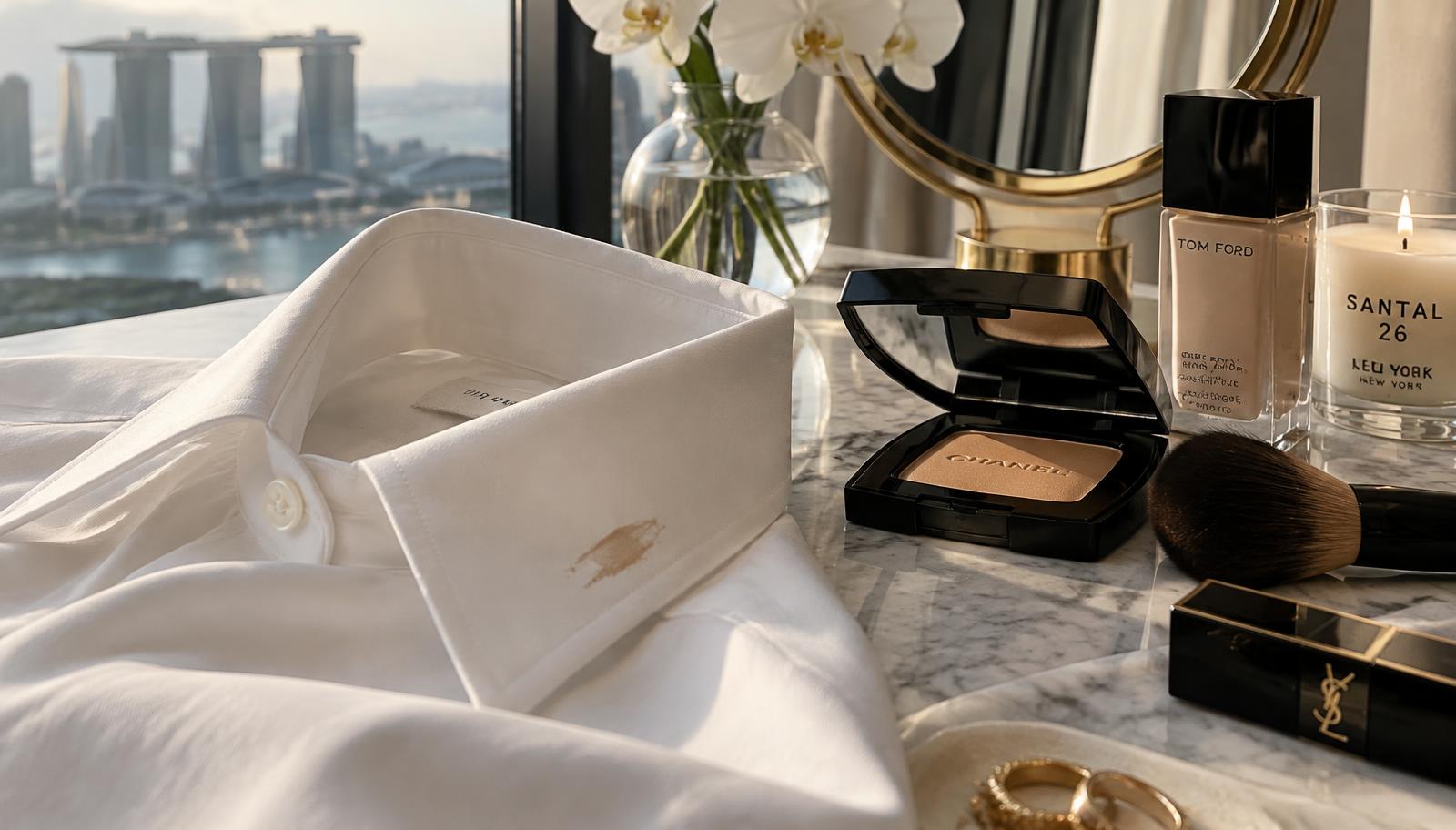
A white top is the most honest garment you own. It records the morning’s foundation, the afternoon’s sunscreen and the long week at the collar, and it does not forgive delay. The same crisp poplin that looks flawless on Monday can look quietly tired by Friday, and rarely because of anything dramatic. It is the small, daily transfers that accumulate: a trace of base at the neckline, a film of SPF on the shoulder, a faint ring where skin meets fabric.
The reassuring part is that almost all of these marks are oil-based or wax-based residues sitting on the surface of the weave, and residues of that kind respond beautifully to gentle, patient treatment, provided nothing hot, harsh or hurried reaches them first. This guide explains what each stain actually is, the method that lifts it, which fabrics can be treated at home, and which belong in expert hands.
Why White Tops Tell on You
Foundation, sunscreen and lipstick are engineered to do one thing: stay put. Pigments are suspended in oils, silicones and waxes so they cling to skin through a full day of heat and movement. Unfortunately, they cling to fabric in exactly the same way. Because a collar sits against the jaw, neck and hairline, it collects skin oils, sweat, base and fragrance all at once. The result is rarely a single spill. It is a slow build-up.
Singapore adds its own variables. In constant heat and humidity, skin products soften and migrate, and perspiration carries them into the fibres faster than they would travel in a cooler climate. A top that is worn for a long day, moves between air-conditioning and the outdoors, and goes into the laundry basket slightly damp gives residue every advantage.
Know the Stain Before You Treat It
The right first move depends on what you are dealing with. A powder behaves nothing like a cream, and a sunscreen stain follows entirely different rules from a lipstick mark. Use this table as your starting point.
| Stain | What it is | First move | Avoid |
|---|---|---|---|
| Liquid or cream foundation | Pigment in an oil or silicone base | Lift excess, then dab with micellar water | Rubbing; hot water |
| Powder, blush, bronzer | Dry pigment with binders | Shake off, lift with tape or a soft brush | Wetting it first, which turns it to paste |
| Lipstick | Wax, oil and pigment | Blot, then dab from the reverse side | Spreading it with a damp cloth |
| Chemical sunscreen | Oil-soluble filters; can leave a yellow-orange shadow | Pre-treat with dish soap before washing | Chlorine bleach |
| Mineral sunscreen | Fine mineral particles in an oil base | Loosen with detergent, rinse thoroughly | Dry brushing it into the weave |
| Collar ring | Sweat, skin oils and product build-up | Detergent paste and a soft brush | Chlorine bleach; hot water |
Your Stain Kit: Five Things Worth Keeping
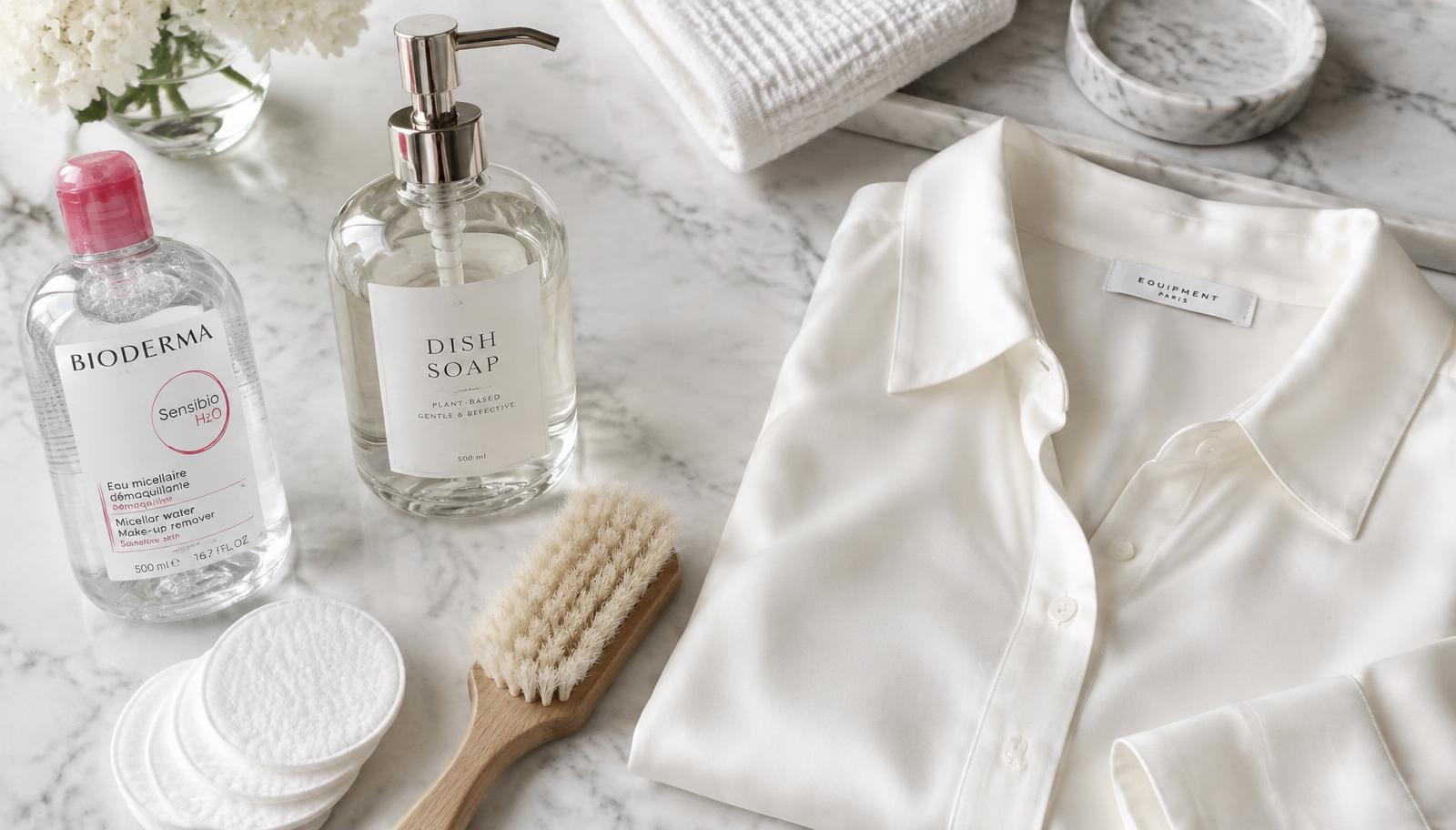
Micellar water, a gentle dish soap, a soft brush and cotton pads: the whole kit fits in a drawer.
You do not need a cupboard of specialist products. A small, deliberate kit handles the vast majority of white-top accidents:
- Micellar water. Designed to dissolve makeup without harshness, it is ideal for pigment and oil on cotton, linen and synthetics. Choose a fragrance-free one.
- A clear, mild dish soap. Dish soap is formulated to break down grease, which is exactly what foundation and sunscreen are. Choose clear rather than coloured so no dye reaches a white garment.
- A soft-bristle brush. Soft enough to work a detergent paste into a collar band without roughing the weave.
- White cotton pads and a plain white towel. Always white, so there is no chance of dye transferring onto the garment you are trying to save.
- An oxygen-based whitener. For white cotton and linen only, it brightens without the damage chlorine bleach can cause. Follow the product’s own directions.
Foundation and Makeup: The Blotting Method
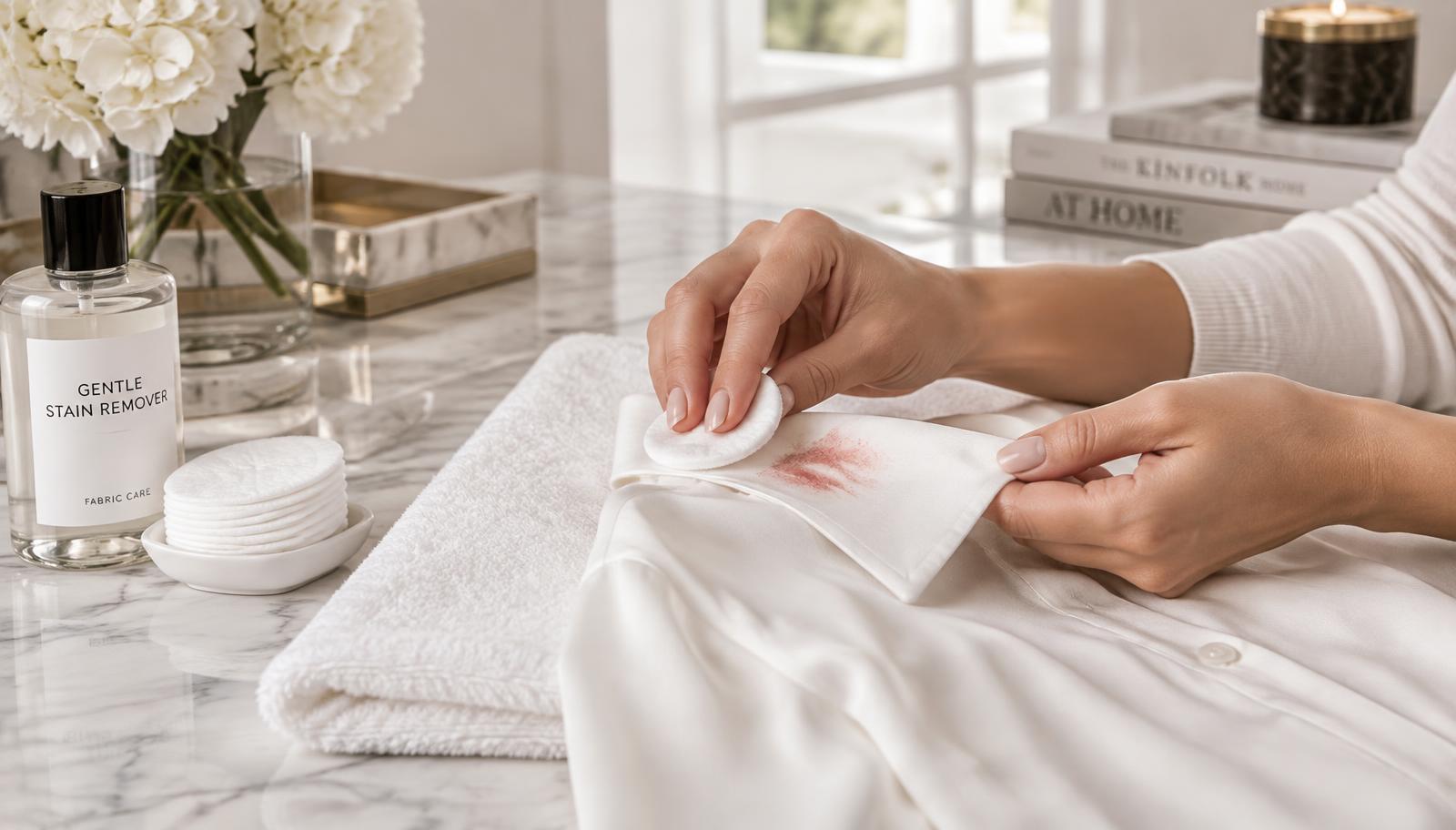
Dab, never rub: a white towel beneath the stain draws the pigment out of the fabric rather than through it.
The same technique works for foundation, concealer, lipstick and blush. The principle is to dissolve the pigment and lift it out, never to grind it into the weave.
- Remove what you can without touching the stain. Shake off loose powder, or lift it with a piece of tape or a soft brush. For liquid or cream formulas, gently lift the excess with the blunt edge of a card. Never wipe.
- Put a white towel underneath. Slide it directly beneath the stained area so the pigment transfers into the towel instead of spreading through the garment.
- Dab with micellar water. Soak a cotton pad and press it onto the stain, working from the outer edge towards the centre so the mark does not spread. Change to a clean pad as soon as one picks up colour.
- Follow with a single drop of dish soap. Add a few drops of cool water and work it in gently with a fingertip or soft brush, using small, light circles.
- Rinse from the back. Hold the fabric under cool running water with the stain facing down, so the residue is flushed out rather than pushed deeper.
- Check in daylight before any heat. If a shadow remains, repeat. Once it is truly gone, launder as the care label directs and air dry.
Sunscreen: The Yellow-Orange Shadow

Daily SPF is non-negotiable in Singapore, and so is knowing what it does to a white top.
Sunscreen is the sneakiest stain of all, because it often does not look like a stain on the day. The mark appears after the third or fourth wash as a faint yellow or orange shadow along the collar, shoulder or sleeve. This is because many chemical sunscreen filters can react with minerals, such as iron, present in water and fabric finishes, forming a coloured residue that heat then sets. Mineral formulas behave differently: they leave a chalky film that is subtle on white, but gradually dulls it.
The secret is to treat before the wash, not after it:
- Pre-treat on the day. Work a little dish soap or liquid detergent into any area that has met sunscreen and leave it for about fifteen minutes before laundering.
- Wash at the warmest temperature the label permits. Warmth helps dissolve oily residue, but never exceed what the garment can take.
- Inspect before drying. If any yellow shadow remains, treat again. Dryer heat or an iron will lock it in permanently.
- Use an oxygen soak for stubborn marks. On white cotton and linen, a soak in an oxygen-based whitener, made up as the product directs, can lift a lingering shadow.
The Collar Ring: A Stain in Slow Motion
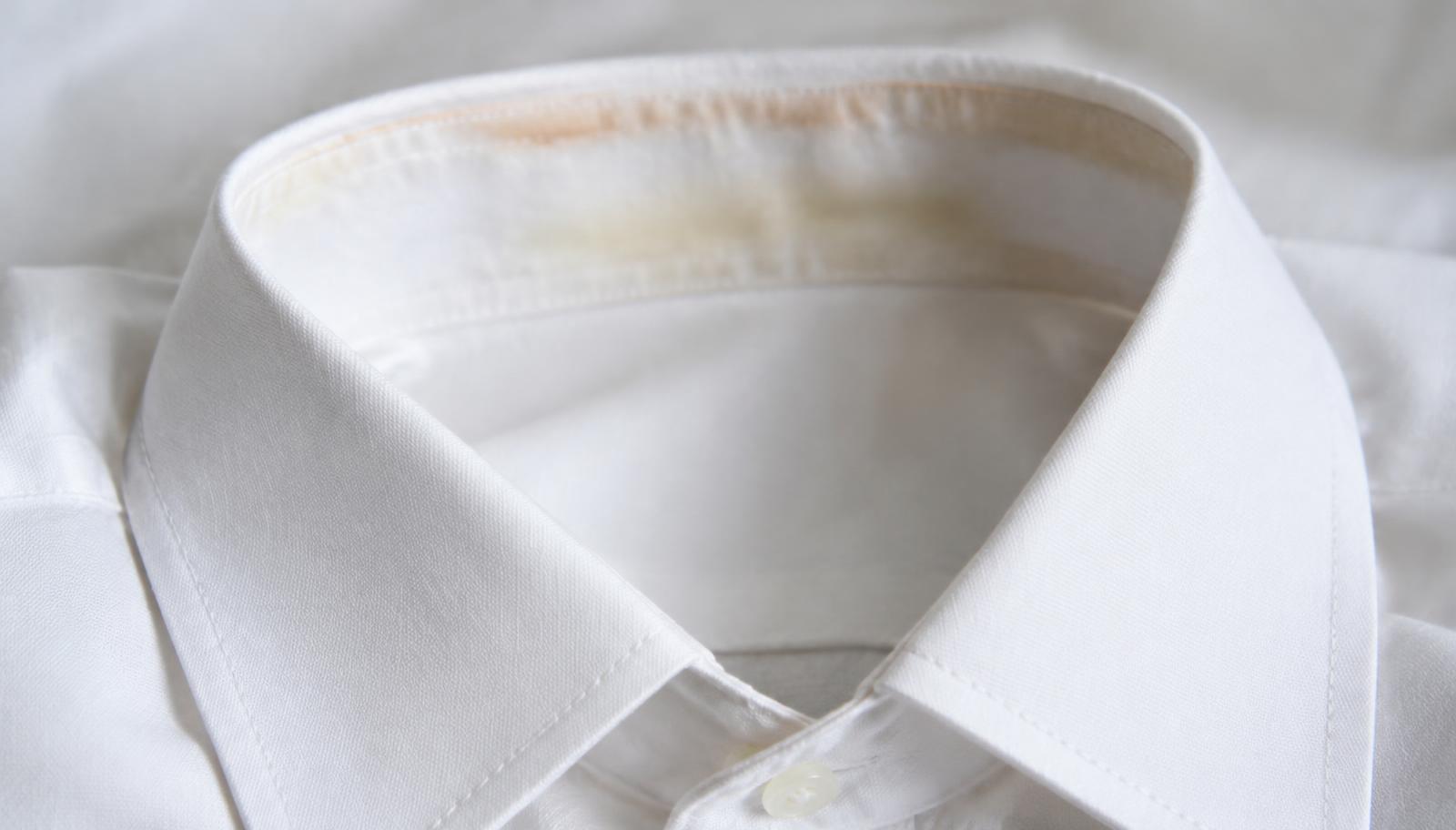
Not one stain but hundreds of tiny ones: skin oil, sweat and product, layered wear after wear.
The ring around the collar is not caused by a single event. It is the accumulated trace of skin oils, perspiration, foundation at the neckline, sunscreen, perfume and hair products, each wear adding another translucent layer. Standard washing removes the surface but often leaves the oily core of the build-up behind, which is why the ring returns.
- Treat the collar band before it goes in the machine. Do not simply drop the shirt in the basket and hope.
- Apply a detergent paste. Mix an enzyme-based laundry detergent with a little cool water, or use liquid detergent neat, and work it into the inside band and the underside of the collar with a soft brush.
- Let it rest for twenty to thirty minutes. Time does most of the work. Resist the urge to scrub harder.
- Launder as the label directs, with the collar facing outwards if the garment is going in the machine.
- Check before drying. If a faint ring remains, repeat the treatment. Heat will fix it permanently.
Fabric by Fabric: Where Home Treatment Ends
Everything above assumes a sturdy cotton shirt. White tops come in many fabrics, and each has its own limit.
Cotton Poplin & Oxford
The most forgiving white. It tolerates the full method: micellar water, dish soap, and an oxygen soak if needed.
Safe to treat at homeLinen
Treat as cotton, but handle softly. Wet linen is fragile, so dab rather than brush and always air dry.
Home, with a light touchSilk & Satin
Water can leave rings, and enzymes and chlorine damage the protein fibre. Lift loose powder, blot only, and go to a professional promptly.
Professional onlyCashmere & Fine Knits
Dab only, with cool water and a mild soap. Rubbing felts the surface. When in doubt, hand it over.
Spot-test, or professionalPolyester & Satin Blends
Synthetics hold on to oil stubbornly. Dish soap works well; keep rinse water cool and avoid high heat.
Dish soap, cool rinseViscose & Rayon
Weaker when wet. Blot lightly, spot-treat only, and never soak or twist the fabric.
Spot-treat onlyTailored & Structured Shirts
Fused collars, linings and shaped seams do not tolerate soaking or scrubbing. Professional finishing keeps the structure intact.
Professional onlyEmbellished & Beaded Tops
Brushing and moisture can loosen beads, sequins and trims. Do not treat at home.
Professional onlySeven Mistakes That Turn a Stain Into a Permanent Mark
- Rubbing. Friction drives pigment into the weave and roughens the surface, leaving a dull patch even after the colour is gone.
- Starting with hot water. Heat can set sweat and makeup residue. Begin cool and only warm up if the label allows.
- Reaching for chlorine bleach. It can yellow sweat and sunscreen residue and weaken delicate fibres.
- Drying or ironing before checking. Heat is the point of no return. Always inspect the area, wet and dry, first.
- Using coloured towels or pads. Dye can transfer onto a damp white garment. Keep everything in the process white.
- Using acetone or nail polish remover. It can dissolve acetate and some synthetics, leaving a hole rather than a clean top.
- Waiting. Oils oxidise over time, and a stain that would have lifted in minutes can take specialist treatment after a few weeks.
The Singapore Factor: Heat, Humidity and SPF
Prevention is easier than treatment, and in this climate it is worth building into the morning routine. A few small habits keep transfers to a minimum:
- Let it set. Give sunscreen, moisturiser and foundation a few minutes to absorb before dressing. Wet product transfers; settled product barely does.
- Choose button-front tops on full-makeup days. You step into them rather than pulling them over a finished face, which removes the biggest source of neckline marks.
- Powder last and brush down. Sweep loose powder away from the collar before you put the top on.
- Do not let a worn white top sit in the basket. Hang it to air first. In humid conditions, damp, product-laden fabric is where yellowing and odour begin.
- Wash collars after every wear. In a warm, humid climate this is the safest rule, and it stops the ring from ever forming.
- Treat the same evening. A five-minute spot treatment tonight saves a specialist job next month.
Frequently Asked Questions
Can I use micellar water on any white top?
It works well on cotton, linen and most synthetics. Spot-test on a hidden seam first, and avoid it on silk and other delicate fabrics, which should go to a professional.
Why does a stain disappear when wet and reappear once dry?
Residual oil can look transparent while the fabric is damp and re-emerge as it dries. This is why you should never apply heat until the area has been checked dry in daylight.
Do toothpaste, hairspray or rubbing alcohol work on makeup stains?
They are popular home remedies, but they can leave residue or affect dyes and finishes. A makeup-friendly cleanser and a drop of dish soap are gentler and more predictable.
Is it safe to use chlorine bleach on a white shirt?
We would avoid it on collars and any area exposed to sunscreen or sweat, where it can cause yellowing. An oxygen-based whitener is the safer option for white cotton and linen.
Can an old, set collar ring still be removed?
Often it can be improved, but there is no guarantee. Older, heat-set residue is harder to lift, so the sooner a professional sees it, the better the chance of restoring the garment.
The Verdict

A wardrobe of whites stays luminous through speed, gentleness and the right method.
White tops do not stay immaculate by luck. They stay immaculate because the first ten minutes after a transfer are handled well: blot, dissolve, rinse cool, inspect and only then apply heat. Treat the collar before it becomes a ring, treat sunscreen before it becomes a shadow, and keep chlorine bleach for another day. And for the silks, the tailoring and the pieces you cannot replace, let someone with the right tools take over.
Piing picks up, cleans and finishes every garment exactly the way its fabric demands, then delivers it back, ready to wear. Pickup & delivery across Singapore
Let Piing! handle the laundry and dry cleaning. Book a pickup and get your clothes collected, cleaned and delivered across Singapore — no store visits, no hassle.
Book a Pickup →