
There is a particular kind of heartbreak reserved for the moment you open a storage box after eleven months. The cashmere coat you paid a small fortune for has a constellation of tiny holes across one shoulder. The cream silk blouse has bloomed a faint yellow shadow under the arms — a stain that was not there when you put it away. The wool suit smells like a cupboard.
None of this happened by accident, and none of it happened because the garments were badly made. It happened because they were put away in the wrong condition, in the wrong container, in the wrong place.
Storage is the least glamorous part of owning beautiful clothes and, by a wide margin, the most consequential. A garment spends perhaps thirty days a year on your body. It spends the other three hundred and thirty-five in the dark, and what happens in that dark decides whether it lasts three years or thirty.
This is how to put a wardrobe away properly — the way archivists, tailors and professional garment-care teams do it.
The eight rules of seasonal storage
- Never store a garment unwashed. Invisible residue is what attracts damage.
- Never store anything even slightly damp. Mildew needs only a few days.
- Knitwear is folded. Structure is hung. Getting this backwards ruins shape.
- Cotton and acid-free tissue, never plastic. Fabric must breathe.
- Cedar and lavender, not mothballs. Repel, do not fumigate.
- Cool, dark and dry. Light fades, heat yellows, damp destroys.
- Label everything. You will not remember which box holds the coats.
- Air it before you wear it. Storage smell is real, and it lifts in a day.
1. Clean everything — even the things that look clean
This is the rule people break most often, and it is the one that causes the most expensive damage.
A jumper worn twice looks perfectly clean. It is not. It carries body oils, perspiration salts, perfume, hairspray, skin cells and traces of whatever you ate — all of it invisible, all of it food. Clothes moth larvae do not actually eat clean wool very well. What they seek out is wool that has been seasoned with human residue, which is exactly why moth damage appears at the collar, the cuffs and the underarms rather than randomly across a garment.
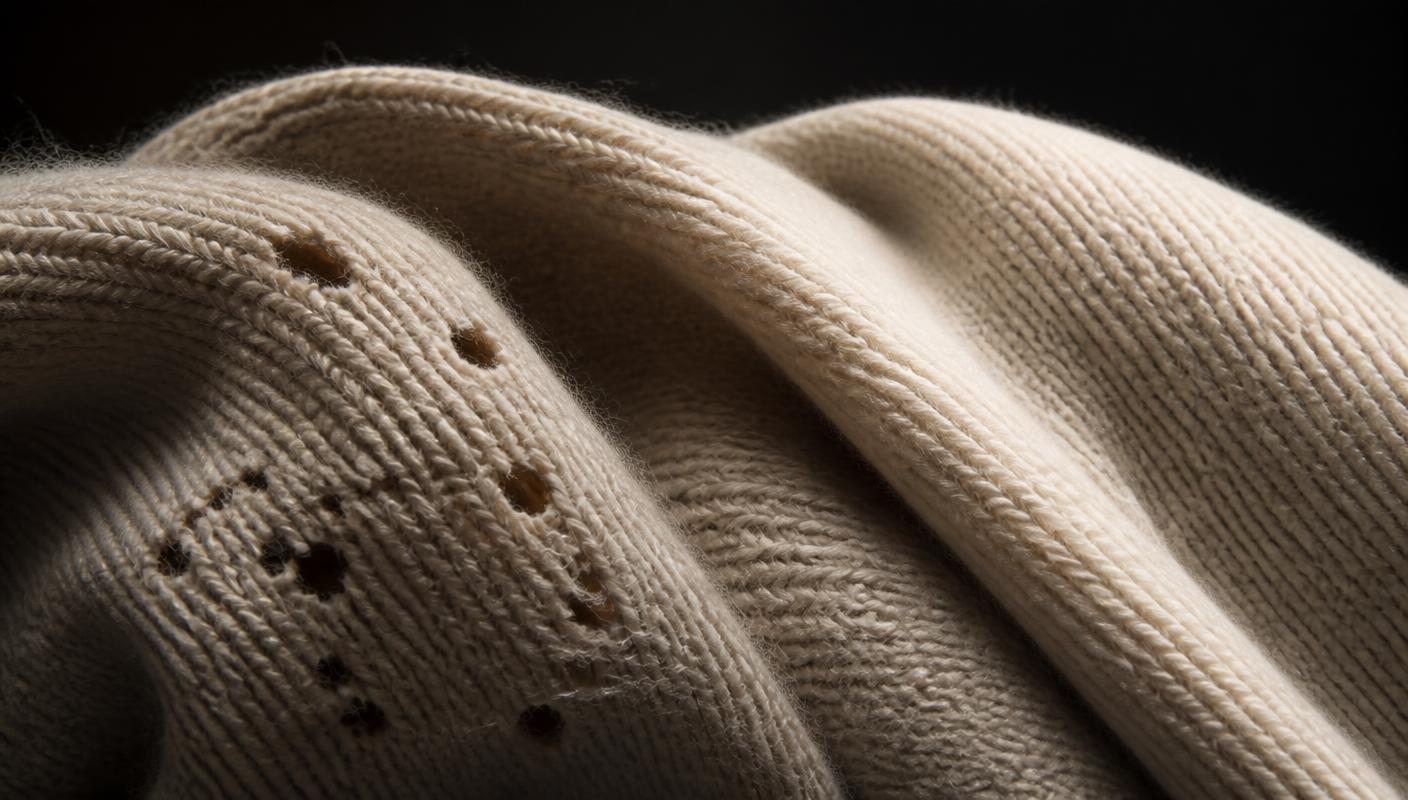
Moth damage clusters where body oils collect — collars, cuffs and underarms. It is a hygiene problem, not a luck problem.
The second reason is chemistry. Sugars, alcohol, fruit juice and perspiration are often invisible when fresh and violently visible after a year. They oxidise slowly in the dark and emerge as brown or yellow patches that no amount of later washing will lift, because by then the stain has bonded to the fibre. This is why a white shirt can go into storage flawless and come out marked.
Wool, cashmere, silk and anything tailored should go to a professional before it goes into a box. Ask for it to be returned without the plastic sleeve, or remove the sleeve the moment it arrives.
2. Bone dry — not "probably dry"
A garment that feels dry to the hand can still hold several percent moisture, particularly in a thick knit, a padded shoulder or a densely woven cotton seam. Sealed into a box in a humid climate, that moisture has nowhere to go, and mildew begins within days.
The test is simple: press the thickest part of the garment — the seam, the waistband, the shoulder pad — against the inside of your wrist. If it registers cool, it is still holding water. Give it another day.
3. Fold or hang? Get this wrong and nothing else matters
The decision is about one thing: whether the fabric can hold its own weight for a year.
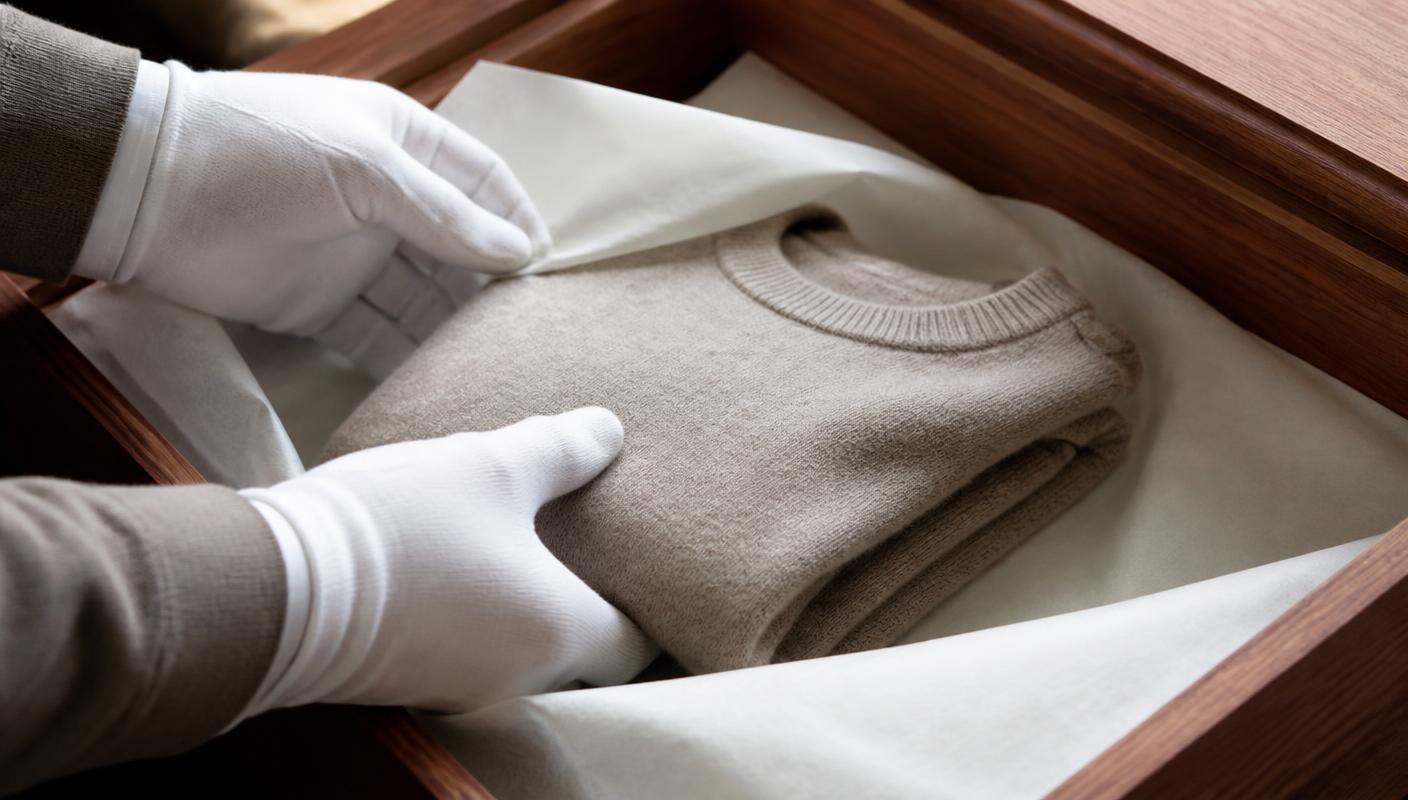
Fold: cashmere, wool knits, cotton jumpers, T-shirts, jersey, beaded pieces
Hang a cashmere jumper for twelve months and gravity will pull the shoulders into permanent points and stretch the body into a shapeless tube. Knit has no internal structure — it simply follows whatever force is applied to it. Fold it.
The professional fold: lay the garment face down, fold each sleeve straight back along the body, fold the body in half or thirds, and lay a sheet of acid-free tissue inside each fold so the crease is soft rather than sharp. Never fold on a hard crease line twice in a row — a permanent fold mark in cashmere is very difficult to remove.
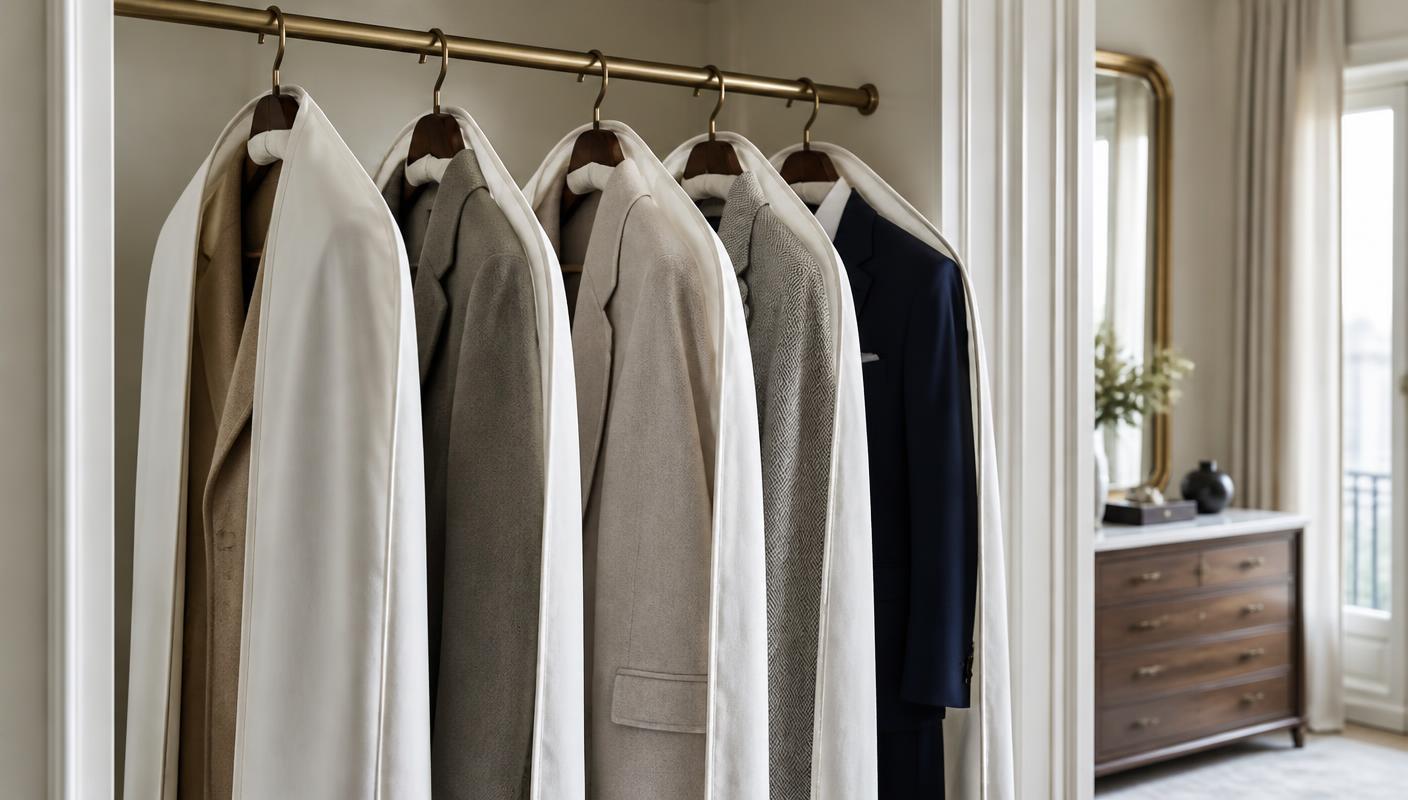
Hang: coats, blazers, tailoring, structured dresses, heavy outerwear
Anything with a canvassed chest, a shoulder pad or a lining needs to keep its three-dimensional shape, and folding will crush it. Use broad, padded or contoured wooden hangers — never wire, never thin plastic. A wire hanger concentrates the full weight of a wool coat onto two narrow points and will leave dimples in the shoulder that survive steaming.
4. What you store it in matters more than where
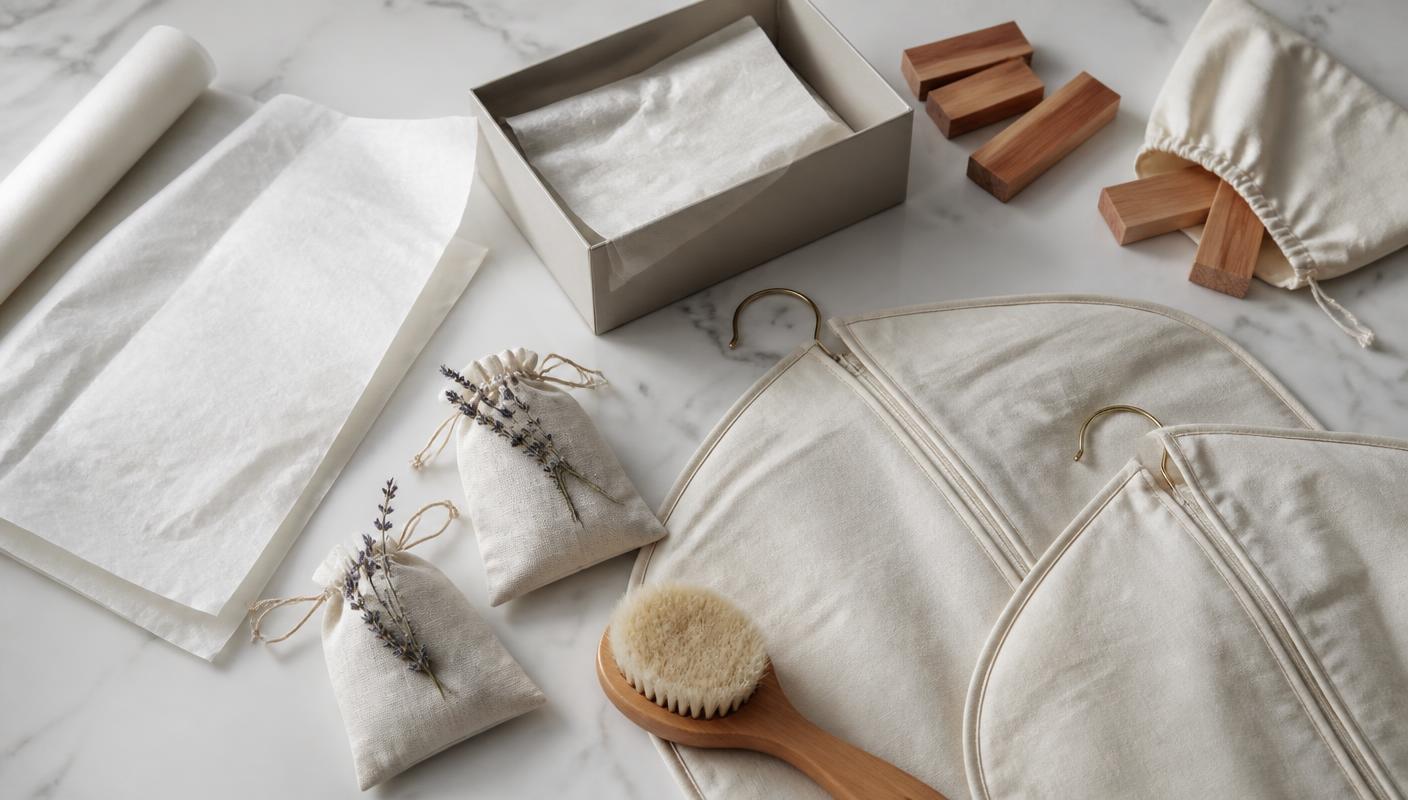
The complete storage kit: acid-free tissue, breathable cotton bags, cedar, lavender and a soft brush. Nothing plastic.
Use
- Acid-free tissue paper — buffers folds, absorbs stray moisture and prevents dye transfer. Ordinary tissue and newspaper are acidic and will yellow fabric over time.
- Breathable cotton or canvas garment bags — protect from dust and light while letting air move through.
- Rigid fabric-sided boxes or cedar drawers — hold shape without crushing.
- Cotton pillowcases — a genuinely excellent free option for individual knits.
Avoid
- Plastic tubs and zip bags — they seal moisture in and can off-gas onto fabric.
- Vacuum bags — the single worst thing you can do to natural fibre. Compression crushes the loft out of down, wool and cashmere, and some of it never comes back.
- Cardboard boxes — acidic, and a favourite habitat for silverfish.
- Dry-cleaning plastic — designed for a car journey, not a year.
5. Moths, mould and silverfish — the three thieves
Every storage pest has a different appetite, and each has a different defence.
| Threat | What it attacks | What it looks like | Defence |
|---|---|---|---|
| Clothes moths | Wool, cashmere, silk, feathers, fur | Small irregular holes, fine webbing, sandy grains | Clean before storing; cedar; sealed cotton bags; annual airing |
| Mildew & mould | Anything damp, especially cotton and linen | Musty smell, grey or black speckling | Full drying; silica gel; dehumidifier; airflow |
| Silverfish | Starched cotton, rayon, paper, cardboard | Irregular grazed patches and yellow marks | No cardboard, no starch, keep the space dry |
| Light | Dyed fabric, especially silk and denim | Faded shoulders and folds | Opaque bags; dark storage |
Cedar and lavender, not mothballs
Cedar blocks work by repelling adult moths with aromatic oil — but only while they smell of cedar. Sand them lightly with fine sandpaper every six months to reopen the pores and restore the scent. Lavender sachets do the same job and smell considerably better in a bedroom wardrobe.
Mothballs (naphthalene or paradichlorobenzene) do work, but they are a pesticide that sublimates into the air you breathe, the smell embeds itself in fibre for years, and the residue can damage some plastics and finishes. In a home, they are not worth it.
6. Where you put the boxes

Cool, dark, dry and off the floor — the four conditions that matter more than any container you choose.
The ideal storage environment is cool, dark, dry and stable. Stability matters as much as the numbers: fabric that repeatedly warms and cools takes on and releases moisture with every cycle, and that constant movement is what breaks fibres down.
- Good: the top shelf of an interior wardrobe, a spare-room cupboard, a dedicated storage room, under-bed drawers with the box lifted off the floor.
- Bad: a bathroom cupboard, a balcony store, an attic, a garage, anywhere against an exterior wall that gets afternoon sun, or directly on a floor that could flood.
Leave a hand's width of air between boxes and between hanging garments. Crammed storage restricts airflow, and restricted airflow is how a small damp problem becomes an entire ruined shelf.
The Singapore humidity factor
Everything above applies twice as strongly here. Singapore sits at 70–90% relative humidity year-round, which means the ambient air alone is enough to grow mildew inside a sealed box — no spill, no damp garment, no mistake required.
- Run a dehumidifier in the storage room or wardrobe. Target 45–55% relative humidity. This is the single highest-impact thing you can do.
- Add silica gel packs to every box — the large reusable kind. Dry them out in the sun or a low oven every few months and they work indefinitely.
- Never store against an exterior wall. Condensation forms on the cool side of that wall and migrates into whatever is touching it.
- Open the wardrobe regularly. Five minutes of airflow a week prevents the stagnant pocket where mould begins.
- Check at the halfway mark. Open every box once around the six-month point, air the contents for an hour, and repack. This one habit catches problems while they are still reversible.
- Skip charcoal deodorisers in sealed boxes — they absorb odour but do nothing for moisture, and they can leave marks on pale fabric.
Fabric by fabric
🧣 Cashmere & fine wool
Clean first, without exception. Fold with acid-free tissue between layers, store in a cotton bag or pillowcase with cedar nearby but not touching. Never hang, never vacuum-seal.
Fold — clean first🧥 Wool coats & tailoring
Professionally cleaned, then hung on a broad wooden hanger inside a breathable cotton bag. Fasten the top button so the shoulders and lapels hold their line.
Hang — padded hanger👗 Silk & satin
Extremely light-sensitive and prone to permanent creasing. Roll rather than fold where possible, interleave with tissue, and keep in complete darkness.
Roll in tissue🪶 Down jackets & puffers
Must be stored loose and uncompressed so the down keeps its loft. A large breathable bag on a shelf. Compression is what kills a good down jacket.
Loose — never compressed👖 Denim & heavy cotton
The most forgiving category. Wash, dry completely, fold flat. Keep out of direct light — indigo fades along the fold lines faster than anywhere else.
Fold — easy👘 Linen
Store loosely folded with generous tissue. Packed tight, linen sets hard creases that need a full wash and press to release. Never starch before storing.
Fold loosely✨ Beaded & embellished
Always flat, always face up, always with tissue supporting the weight of the beading. Hanging tears embroidery threads out of the base fabric over months.
Flat — fully supported👞 Leather & suede
Needs air more than anything else. Breathable bag only, stuffed with tissue to hold shape, kept away from heat. Sealed plastic causes irreversible mould.
Air — never sealedNever do this
- Storing anything unwashed, however clean it looks
- Vacuum-sealing wool, cashmere or down
- Leaving garments in dry-cleaning plastic
- Hanging heavy knitwear for a season
- Using cardboard boxes or newspaper
- Storing in a bathroom, balcony store or anywhere with sun
- Applying perfume or deodorant to a garment before putting it away
Unpacking next season, properly
Bringing a wardrobe out of storage deserves the same care as putting it in.
- Air everything for 24 hours before it goes anywhere near your body. Storage smell almost always lifts on its own.
- Shake and brush. A soft garment brush lifts dust and revives the nap on wool and cashmere.
- Steam, do not iron. Steam relaxes stored creases without flattening the pile of a knit or scorching silk.
- Inspect under good light. Look for small holes, faint yellowing or a musty note at the collar — all of which are far easier to fix if caught immediately.
- Refresh anything worn last season before it re-enters rotation.
Frequently asked questions
How long can clothes safely stay in storage?
Indefinitely, if the conditions are right — museums store textiles for centuries. In practice, check and air your boxes once every six months and nothing will ever get far enough to become a problem.
Do I really need acid-free tissue, or is normal tissue fine?
For anything valuable, yes. Ordinary tissue and newspaper contain acids and lignin that yellow fabric over time, and newsprint transfers ink. Acid-free tissue costs very little and is the difference between a white blouse staying white and turning cream.
Is it safe to store clothes under the bed?
Yes, provided the container is breathable, sits slightly off the floor, and the room is not damp. Under-bed storage is dark and stable, which are two of the four things you want.
Should I wash clothes again when I take them out?
Usually not. If they went in clean and come out clean, airing and steaming is enough — and an unnecessary wash is just extra wear. Wash again only if there is a smell, a mark, or the item was stored more than a year.
What is the best way to store a wedding dress or heirloom piece?
Professional cleaning, then flat storage in an acid-free box with tissue supporting every fold and the bodice, kept in total darkness at stable temperature. Never hang it — the weight of the skirt will eventually tear the shoulder seams.
Do cedar blocks actually work?
They repel adult moths while they still smell strongly of cedar, which is roughly six months. Sand them lightly to refresh the scent. They will not kill an existing infestation — cleaning and freezing does that.
The verdict
Good storage is not about expensive containers. It is about condition — the state a garment is in on the day you close the lid. Everything that goes wrong in storage was already present, invisibly, on that day.
If a season's worth of coats, cashmere and tailoring feels like a large job, it is. Piing collects, professionally cleans and returns everything storage-ready, without the plastic — so all you have to do is fold it away.
Let Piing! handle the laundry and dry cleaning. Book a pickup and get your clothes collected, cleaned and delivered across Singapore — no store visits, no hassle.
Book a Pickup →